AI Eval Tools
Every time I want to compare models, prompts, or agent harnesses I trip over the same question: which eval tool? Strip the branding and they are all the same eight parts. They split on two questions: does the tool run the agent somewhere and look at what it did, or call a function and look at what it returned? And are runs saved so I can re-grade them without paying for them again? For agent work that leaves smevals (my own weekend evals) and Terminal-Bench (standard harness benchmarks). This is a quick survey, not a considered review: I’ve only used two of these in anger, and the versions move fast.
AI-augmented, roughly 95% AI (what this means)
I love AI, and I use it on posts like this one partly to get better at using it. The percent is a rough guess: after rounds of prompting, rewriting and editing, it's very hard to say which words came from whom.
- What I want from an eval tool
- Our benchmark evals
- The shared anatomy: same concepts, different names
- Where the tools split
- The tools
What I want from an eval tool
Criteria, learned while building my first real eval:
- Agent in a workdir. The thing under test is an agent changing files through a harness (Claude Code, Codex), not prompt in, completion out. Models are now trained with their harness and bound to it, so the model-plus-harness score is the one that matters. Same as with people: I judge someone working in their environment, not alone in an interview room.
- Deterministic checkers first: string matches, git diffs, my own tools as oracles. LLM judges are opt-in for quality, never the default gate, and when I use one it answers a list of yes/no assertions and cites the step it’s judging, not a 1–5 score (from Yesha Shah’s Agentic Evals guide).
- Decoupled grading. Runs are immutable records on disk, so a new grader re-scores old runs without re-paying for them.
- Local-first: plain files in a repo, no SaaS account before hello world.
- Cheap authoring: YAML plus small scripts.
- A leaderboard by config × model, with per-task splits. Each task runs k times, reporting pass^k (passed every time) next to pass@k (passed once), with harness failures counted apart from agent failures (also from Shah’s guide).
Our benchmark evals
The honest way to feel out a tool is to build the same evals in each. Every tool I try gets its example in a repo named after the tool, so the examples don’t get lost behind generic names.
Blog page edit. Can an agent make a scoped edit to a page, keep the generated TOC byte-identical to toc.py’s output, and touch nothing else? Built with smevals in smevals-blog-edit-evals; results in Testing AI.
Raccoon generator. My recurring real need: a raccoon illustration in the blog’s house style. Deterministic checks first (file exists, right format, transparent background, sane dimensions), then a vision judge for what only a judge can see: is it a raccoon, and does it match the style. Not built yet. It’s next, and it forces the multimodal-judge question the blog-edit eval dodges.
The shared anatomy: same concepts, different names
Every tool has a case (one exercise), a collection of cases, a target (the model, prompt, or agent-plus-harness under test), somewhere the target executes, a record of each run, a grader, a report, and a way to inspect one run when a number looks wrong. Learn the eight once and any tool’s docs read in minutes:
| Concept | smevals | PromptFoo | Pydantic Evals | Inspect AI | DeepEval | Terminal-Bench | SWE-bench |
|---|---|---|---|---|---|---|---|
| Collection | Eval / Suite | config tests |
Dataset | Task | EvaluationDataset | dataset | dataset + split |
| Case | Task | test | Case | Sample | LLMTestCase | task | task instance, instance_id |
| Target | Config + Runner | provider + prompt | your function | solver + model | your app code | agent | model_name_or_path + patch |
| Execution | any executable, workdir | in-process call | Python call | solver loop, opt docker | Python call | container per trial | container per instance |
| Run record | runs/ dir, immutable |
results cache | report + OTel | .eval log |
test results | job → trials | logs/run_evaluation/ |
| Grader | Grader → Checkers | assertions | Evaluators, judge | Scorers | metrics (G-Eval) | verifier → reward | grading.py → resolved |
| Report | leaderboard CLI | matrix viewer | summary table | log stats | SaaS dashboard | leaderboard | run report JSON |
| Trace view | files + serve |
web UI | Logfire | inspect view |
Confident AI | trajectory, Hub view | none |
Where the tools split
Cases, collections, and targets are commodity; choosing on them is a wash. Two rows decide it.
Execution is the agentic divide. If the tool calls a function and checks the return value (PromptFoo, DeepEval, Pydantic Evals), it can’t naturally test an agent whose real output is changes on disk. If it spawns something in an environment and inspects what it did (smevals, Terminal-Bench, Inspect with docker), it can.
Run record is the iteration divide. If runs are saved and graders apply separately (smevals; Inspect can re-score logs), every new grader idea is free against history. If assertions run inline (PromptFoo, DeepEval), every grader idea re-bills every run.
Against my criteria, where ✓ is yes, ◐ partial or bring-your-own, ✗ no:
| Required feature | smevals | PromptFoo | Pydantic | Inspect | DeepEval | T-Bench | SWE-bench |
|---|---|---|---|---|---|---|---|
| Agent-in-workdir | ✓ | ✗ | ✗ | ◐ | ✗ | ✓ | ✗ |
| Container isolation | ◐ BYO | ✗ | ✗ | ✓ | ✗ | ✓ | ✓ grading |
| Deterministic graders | ✓ | ✓ | ✓ | ✓ | ◐ | ✓ | ✓ |
| LLM judge | ◐ BYO | ✓ | ✓ | ✓ | ✓ | ✓ | ✗ |
| Decoupled re-grading | ✓ | ✗ | ✗ | ✓ | ✗ | ✓ | ◐ reparse |
| Trace viewer | ◐ | ✓ | ◐ SaaS | ✓ | ◐ SaaS | ✓ | ✗ |
| Local-first | ✓ | ✓ | ✓ | ✓ | ◐ | ✓ | ✓ |
Terminal-Bench has the fullest column now that Harbor added judges and regrade, but it is built for standard benchmarks, not for pointing at my own weekend project. That’s smevals’ job. Inspect is the general-purpose heavyweight. SWE-bench is the specialist: unbeatable at “did this patch make the repo’s tests pass,” and uninterested in every other row. The prompt-shaped tools give up both divides for richer judge libraries and viewers.
The tools
Versions as of 2026-08, as a rough signal of how alive each project is.
smevals (0.2.0)
smevals, from Simon Willison and Prime Radiant, is the only tool here built for agent-harness evals out of the box. An eval is a directory of YAML, the Runner and Checkers are any executables, and runs are immutable, so new graders re-score old runs for free. It’s young: the released version lags its own README (-n isn’t shipped, and runs where the harness failed still get graded), there are no built-in judge helpers, and it’s single-machine. My example, smevals-blog-edit-evals, has three tasks, three deterministic checkers, mock runners that validate the graders, and an LLM-judge grader added afterwards.
PromptFoo (0.121.x)
A config-driven prompt × provider × assertion matrix with a strong web viewer and a red-team mode. It’s what I used before smevals: the funnier-LLM and git-summarizer examples, and these test cases in the nlp repo. The unit under test is prompt to completion, so an agent that edits a repo means custom-provider contortions, and re-judging means re-running.
Pydantic Evals (2.x)
From the Pydantic AI team: typed Datasets of Cases run through Evaluators, with a built-in LLMJudge, OpenTelemetry tracing, and a natural pairing with their Logfire service. An eval is a Python program, not a directory of data, so non-Python harnesses feel bolted on. Running and grading are coupled, and local reporting is basic without Logfire.
Inspect AI (0.3.x)
The UK AI Safety Institute’s framework, used for serious public benchmarks: tasks, solvers, and scorers in Python, big parallelism, and a good log viewer. Its standout for agent work is sandbox="docker", which runs each sample’s tool calls in its own container; that’s how SWE-bench (via inspect_evals), Cybench, and GAIA isolate the agent. The cost is heavyweight authoring for weekend-sized evals, and the agent is Inspect’s own Python solver loop, so driving Claude Code or Codex isn’t its native shape.
DeepEval (4.x)
Pytest-style evals with a large library of judge metrics (G-Eval, hallucination, RAG relevance). Most metrics are an LLM call, the dashboards push you to their Confident AI SaaS, and like PromptFoo the unit is a completion, not an agent’s side effects.
Giskard (2.x)
More scanner than eval harness: it probes an LLM app for injection, leakage, and bias. It answers “is this app vulnerable,” not “did the agent do the task right.”
Container-native agentic: Terminal-Bench, SWE-bench, Vivaria
This tier runs agents inside containers, which buys isolation (the agent can safely get full permissions, the sandbox fight I lost on my codex runs), reproducible task images, and parallelism.
- Terminal-Bench is my blog-edit eval, professionalized: each task is a Docker container with setup plus a verifier, and its leaderboard ranks each model inside a real CLI harness (Opus in Claude Code, GPT in Codex). Since Nov 2025 the harness is Harbor; the
tbCLI is the legacy 1.x path. - SWE-bench builds a Docker image per issue and grades on whether the repo’s tests pass. The agent (SWE-agent, now mostly mini-SWE-agent) is a separate layer on top.
- METR Vivaria runs METR’s dangerous-capability evals: agents in containers against their Task Standard.
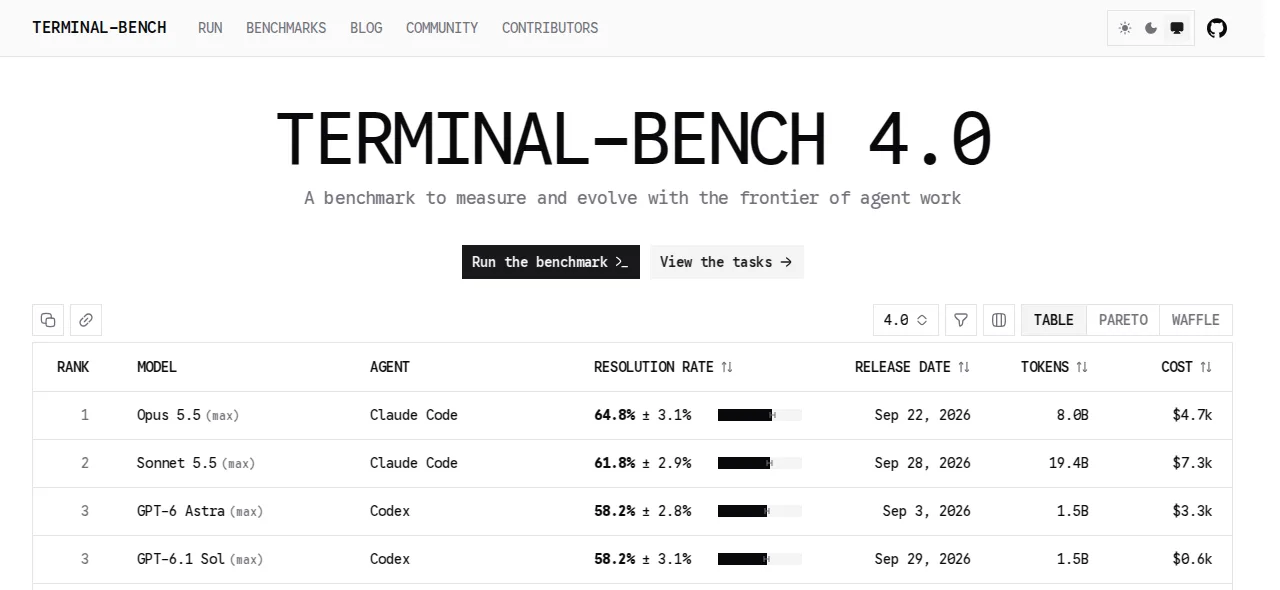
Both benchmarks containerize, but not the same thing, which is what I went looking for. Terminal-Bench puts the agent in the box: it gets a shell, the tests are copied in after its clock stops, and only the final container state is graded (“they do not test the agent’s commands or console output,” per the Terminal-Bench 2.0 paper). SWE-bench puts only the grading in the box: it takes a finished patch, applies it, runs the tests, and tears down. There is no agent code in the benchmark repo. The vocabularies show it: Terminal-Bench’s unit is a trial, “a rollout that produces a reward,” run by an agent; SWE-bench’s is a task instance, and the thing under test is a field called model_name_or_path, from when the subject was a model emitting a diff. Neither is a security boundary: both leave the network open.
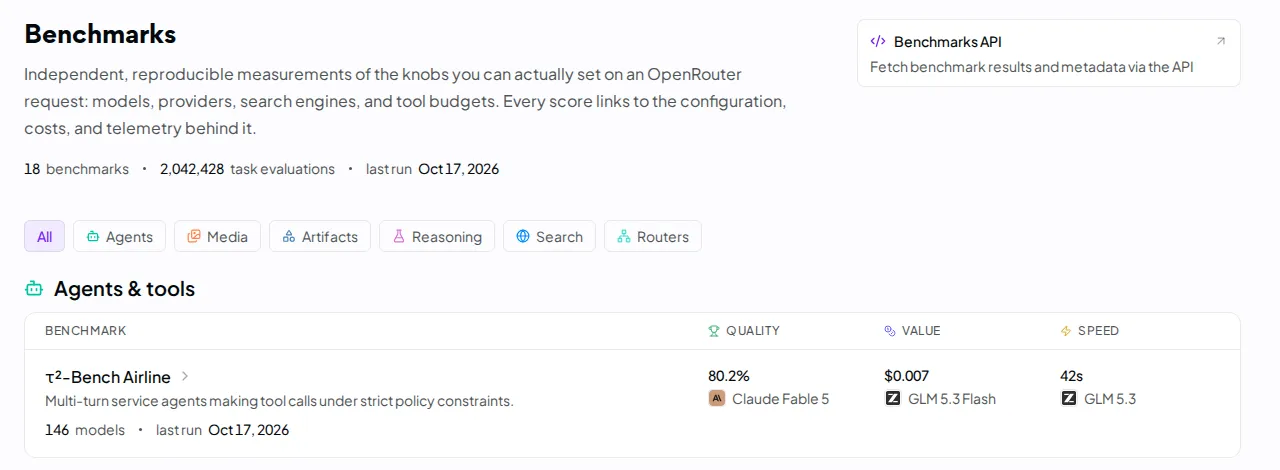
OpenRouter Benchmarks is the other end: no box and no harness, just public benchmarks (τ²-Bench, GPQA Diamond, BrowseComp, image, video, speech) run against OpenRouter API requests, with quality, cost, and speed for each model and config. It’s the table I’d use to pick a model for a raw API call. It can’t tell me how that model does inside Claude Code.
EQ-Bench 4 is the people-skills version: each model holds an eight-turn roleplay with a simulated user persona, and a panel of three LLM judges compares the transcripts pairwise on rapport, attunement, and repairing trust, reported with confidence intervals. Its sibling Spiral-Bench uses the same simulated-user trick to score whether a model pushes back on a user’s delusional spiral or feeds it.
The catch is that these are benchmark-first; custom tasks mean adopting their image conventions. smevals stays out of it: its Runner can docker run when a container runtime exists, but manages none of it.
On a Mac, the catch is where the containers run. OrbStack machines are shared-kernel containers with no user-namespace support (orbstack#2312), so Docker, bubblewrap, and agent sandboxes fail inside them by design. A real Linux VM via Lima (vmType: vz) or UTM brings its own kernel and just works. KVM inside that VM needs an M3 or later, macOS 15+, and Lima’s nestedVirtualization: true (lima#2824).
The SaaS tier: Braintrust, LangSmith, Langfuse
Hosted eval-plus-observability: datasets, judges, traces, dashboards, team features, CI history. If you want a team UI and long-term tracking, this is where it lives. For me it’s account-first with my data off-repo, and my evals are weekend-sized. A directory of runs I can grep beats a dashboard I have to log into.