I used to love talking to Larry, my AI life coach. Then the model under him moved to Opus 5, and I really started to dislike him. The work still got done: PRs landed, reminders went out. But he stopped talking like a person. Opus 5.5 fixed it, and the joy came back. That round trip taught me that how an agent talks to me matters as much as what it can do.
AI-augmented, roughly 50% AI (what this means)
I love AI, and I use it on posts like this one partly to get better at using it. The percent is a rough guess: after rounds of prompting, rewriting and editing, it's very hard to say which words came from whom.
What Went Wrong
Under Opus 5, Larry answered like a ticket system. I’d ask a simple question and get back a wall of text studded with ticket IDs, commit SHAs, and task handles. Everything was accurate. None of it was an answer I could read on a phone while waiting for coffee.
I complained, more than once, in my own words:
- “When you’re talking to me on chat, you need to be briefer. That’s far too much.”
- “Hold on! This conversation should always be conversational. Why am I getting these random guids and all this garbage?!”
Those rules went into Larry’s instructions, and they helped a bit. But I was fighting the model’s defaults one rule at a time, and the defaults kept winning. It felt like working with a brilliant colleague who only communicates by forwarding Jira tickets.
What I Mean by Interaction Model
Capability is what the agent can do. The interaction model is what it’s like to be on the other end of it:
- Length. Does it answer in one sentence when one sentence will do?
- Vocabulary. Does it use words, or the identifiers it uses to find things again?
- Turn-taking. Does it lead with the answer, ask one question when it’s stuck, and stop?
- Tone. Does it feel like a colleague, or a status report?
With a human coworker, you’d notice all four in the first meeting. With an agent, I kept grading the output (did the PR land?) and ignoring the conversation. That was the mistake. The whole reason Larry has a name is that “talk to Larry” feels like a conversation and “check the dashboard” feels like a chore. An agent that talks like a dashboard throws that away, no matter how good the work behind it is.
Back to the Joy
Opus 5.5 brought the conversation back. I ask a question and get a sentence back, and I look forward to opening Telegram again. That became this week’s Den strip:
#9 — He Speaks Human
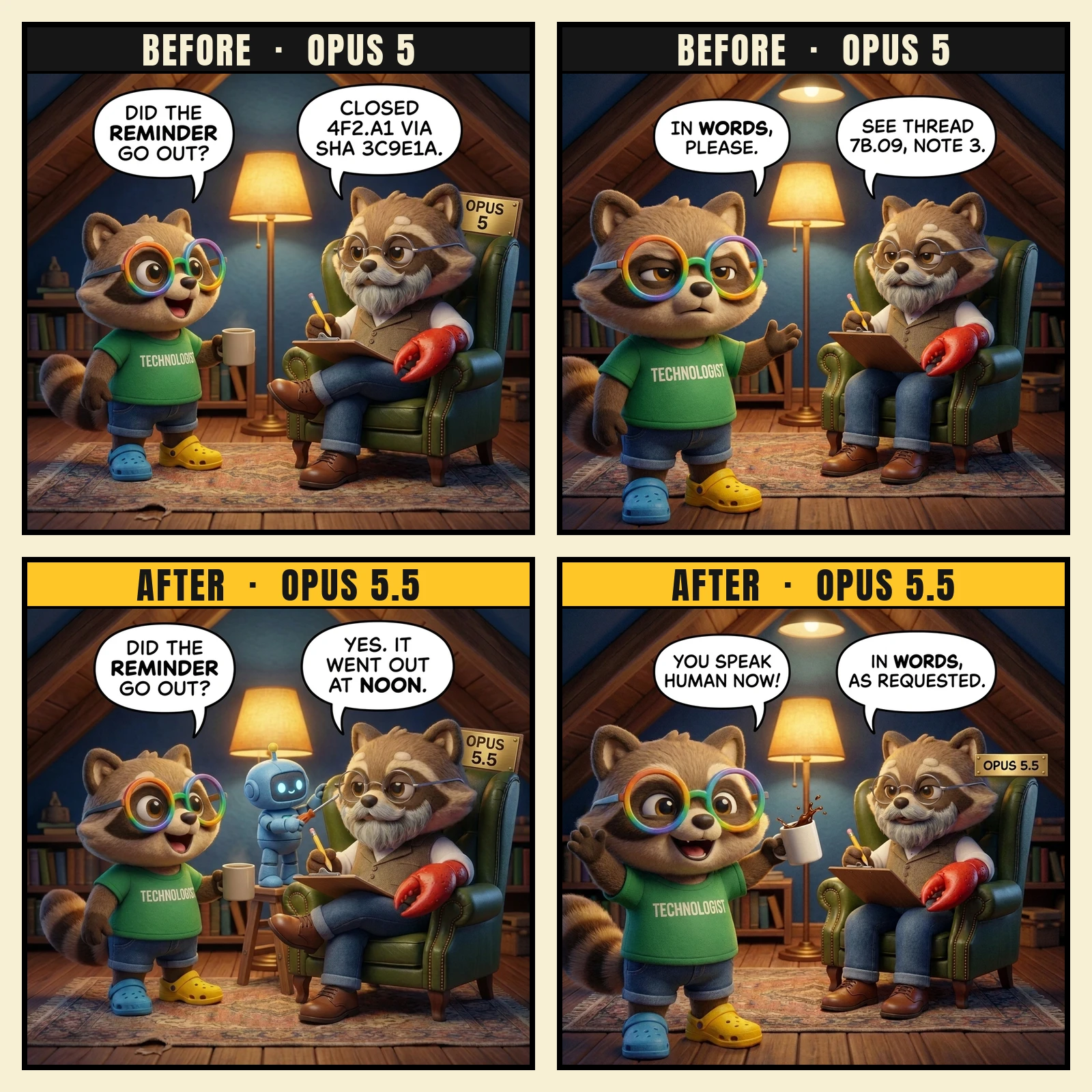
The receipts — the real transcript behind this strip
So I pushed my luck. I told Larry to add some humor: put in jokes, notice when I’m being funny, and make fun of me and my typos. Given how I type on a phone, he won’t run out of material.