Igor's Life Journal
A journal of random life observations. Keeping track of them so I don’t forget what the world did today. Whole days that went well get their own page: Day in the Life.
Upcoming
- Future life vignettes will land here before they get written up.
Diary
2026-07-07
Speed of Light, from Sweden
Working from Sweden this week, hitting my dev box back in Seattle, and the speed of light finally showed up as a number I could feel: ~170 ms round trip — and almost all of it lives in a single hop.
| Segment | Hops | RTT | What it is |
|---|---|---|---|
| Home LAN | 1–4 | ~4.5 ms | OrbStack NAT → router(s) → modem — three NAT layers |
| Seattle metro | 5–6 | ~6–10 ms | CenturyLink/Lumen; Tukwila |
| Seattle backbone edge | 7 | ~7 ms | Lumen sea1 — still in Seattle |
| ⚡ Transatlantic jump | 7→8 | +163 ms | Lumen Seattle → Colt Stockholm, one backbone leg |
| Stockholm delivery | 8–13 | ~170 ms | Colt → Bahnhof → destination |
~7 ms gets me to the edge of Seattle. The Atlantic crossing — Seattle → Stockholm, one backbone leg (Lumen → Colt) — adds ~163 ms all by itself. Once packets are in Stockholm the last mile costs basically nothing.
How fast could it possibly be? Light in glass crawls at about two-thirds of c — roughly 204,000 km/s. Seattle to Stockholm is ~7,600 km great-circle, so the hard floor is about 74 ms round trip in fiber — or ~51 ms if you could shoot it straight through vacuum. I’m seeing ~163 ms, about 2.2× the floor. That gap isn’t waste in the usual sense: real fiber doesn’t fly the great circle. Run the math backward and ~163 ms implies ~16,500 km of actual glass — the packets go down the US and across the North Atlantic, not the straight line a photon would take if it could. Physics sets the floor; geography sends the bill.
Tally: Seattle → Seattle ~6 ms; Seattle → Stockholm ~170 ms; Umeå (far north) ~182 ms. You can’t out-engineer physics — you can only hide it, and 4,000 miles of ocean is hard to hide.
This is the Scandinavian trip talking — planned, like most things lately, with Barry and Larry riding along. The joke writes itself: the assistants that helped me get here now live 170 ms away.
2026-07-01
Meditating in a Church
Sat down in a church and meditated. The quiet a church keeps is a different kind than the quiet anywhere else — easier to borrow than to make.
Barefoot Down the Tower Ramp
Walked the tower ramp barefoot. Wanted to actually feel the thing instead of just being on it — the cold stone, the pitch of the slope, the grit the shoes usually edit out.
Happy Fluff

Saw HAPPY FLUFF on the shelf. It’s exactly how I’d describe my goal in life. Leaving happy fluff everywhere I go.
Dealer of Smiles and Wonder is one of my favorite roles, and happy fluff is that in a tub: nearly weightless, no nutritional value, but brings people joy anyway. Leave a little in every room, walk away smiling.
2026-05-02
Walking with Alex Under the Trees

Saturday afternoon walk with Alex. Trees the whole way — the kind of walk where you stop noticing the trail and just notice the canopy. We weren’t doing anything in particular. He wasn’t telling me a story I’ll remember. I wasn’t telling him one either.
Writing this down because that’s the part that matters. It wasn’t a moment. It was just him, and the trees, and a Saturday. He’s a good friend. Filing it here so future me, reading this back, gets the felt sense of it instead of having to take my word for it.
2026-04-22
How Do You Know Your Son Is an Engineer?

Yesterday Zach was looking at a pizza menu. Sees “30 inches.” Immediately: “That’s a terrible deal for a pizza.”
He doesn’t stop there. Pulls π r². Plugs in 30 → 900π ≈ 2,827 square inches. For four people, ~700 sq in each — six slices a person. Something’s off.
Texts ChatGPT: “how many square inches of pizza does one person eat?” Answer: 80–120, roughly. His number is 6× high.
Debugs. Finds the bug: pizzas are quoted in diameter, not radius. Re-runs with r=15 → 225π ≈ 707 sq in, ~175 each, about two slices a person. Math now plausible. Pizza now reasonable.
Bug fixed. Pride earned.
2026-04-17
Eight Sleep Thinks My Cat Is Me
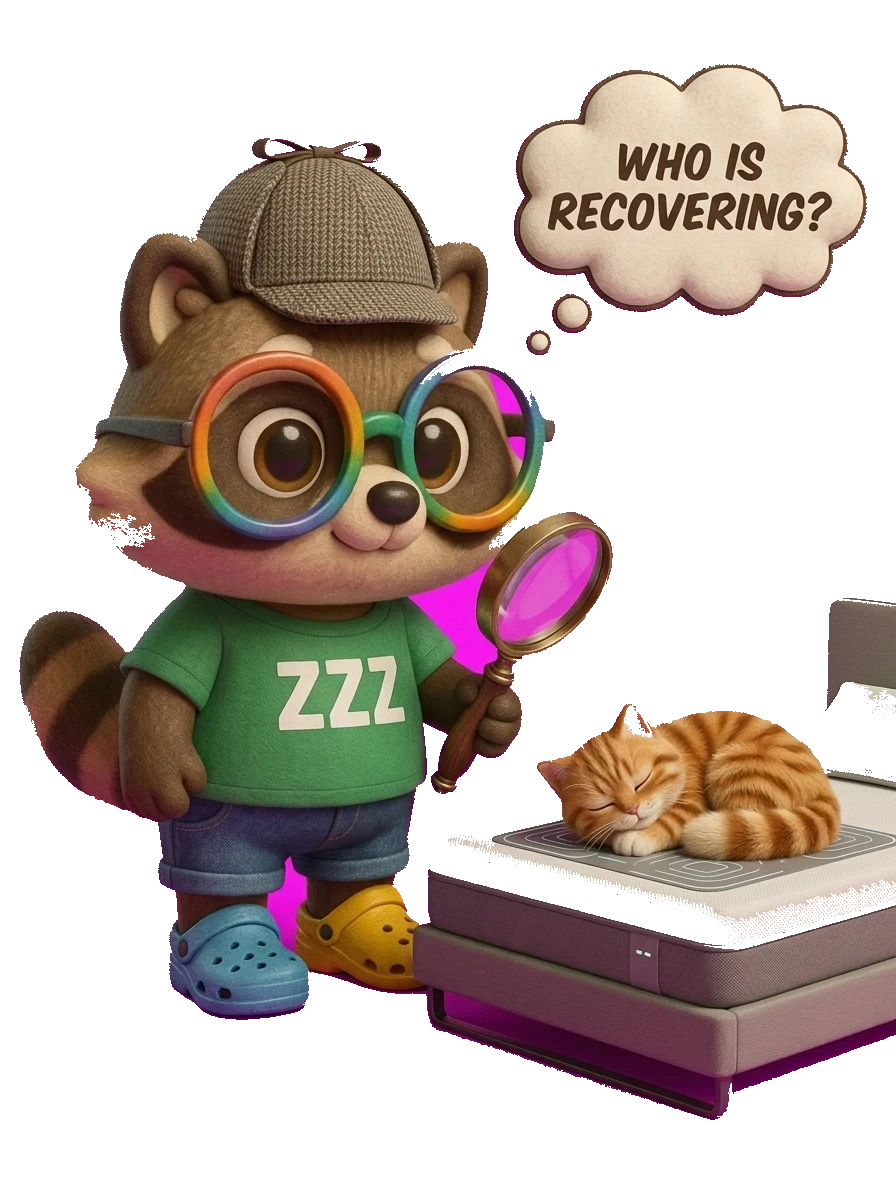
Eight Sleep report this morning: HRV 213 ms on 4h 16m of tracked sleep. My average is ~42 ms. A 5× spike on a vacation night where I slept fine is not a biosignal — it’s a measurement artifact. The parsimonious explanation: the cat was in the bed.
Turns out this is a known thing. Eight Sleep’s pod uses piezoelectric sensors under the cover to pick up ballistocardiographic signals — basically the mattress vibrating from your heartbeat and breathing. A cat curled on the sensing zone puts its own heartbeat in the same waveform. Cat heart rate is 120–220 bpm; mine is ~60. The HRV algorithm mixes the two and produces numbers that look like I’m either dying or a Himalayan monk.
Eight Sleep confirms it in their help docs: pets on the pod “affect accuracy of sleep data.” Their blog post on pets in bed is friendlier about it — thick comforter between pet and cover, or just accept pet-nights as throwaway data.
Takeaway: the 213 ms reading goes in the trash, not the trend. Quantified-self tools are great until they’re measuring your cat. Don’t update your priors on vacation data when you know a confounder was in the bed with you.
Four Pairs of Identical Glasses
Six months ago I got progressives and didn’t like them. The workaround: keep wearing two regular pairs — distance and reading — plus prescription sunglasses. With regular sunglasses in the mix, that’s four pairs of glasses I was rotating through my pockets. I have lots of pockets, but four pairs is too much even for me.
The friction I didn’t count on: all the frames are identical. Every swap was a little decision — pull one out, is this the reading pair or the distance pair? Wrong guess, put it back, try again. Multiply by every time I moved between screen and room and sidewalk. None of it felt expensive in the moment; all of it added up.
Two weeks ago I just decided to fight through the progressives. Wore them, got through the adjustment, and now I can see great with them. One pair in the pocket, sunglasses in the car. The “workaround tax” — swap, fumble, pick the wrong one — was invisibly expensive for six months. Should have pushed through the adjustment period the first week instead of engineering my way around it.
Three Generations of Air Squats
My dad used to just bust out air squats in the middle of whatever. Kitchen, living room, waiting for something to finish on the stove — ten squats, back to whatever he was doing. It wasn’t a workout. It was a tic. He’d also do other random body-weight stuff: calf raises while standing in a line, a few pushups against a counter. The weirder the exercise, the better — that was the whole aesthetic.
Now I do it. I don’t remember deciding to; it just showed up one day as something my body apparently learned by watching. Air squats while the kettle boils, calf raises at the sink, a few pushups against the desk between meetings. Zach has caught me at it plenty of times and given me the teenage eye-roll that says please don’t.
Except: the other day, corner of my eye, I saw him trying it. An air squat in the kitchen when he thought nobody was looking. He will absolutely not admit it, and I did not say anything — call attention and the habit dies before it takes root. But it landed. Three generations of weird body-weight exercises, transmitted by osmosis. Things travel down the family line whether you want them to or not. The air squats got through.
Vibe-Coding from the Passenger Seat
Zach just got his license. He’s driving the Tesla on autopilot, which means the passenger seat is mine and my hands are free. I don’t need a laptop to use that time either. My phone is the keyboard. I fire a voice message at Telegram, a Claude agent on the dev VM at home picks it up, drafts, opens a PR, and pings me back. The car is an office, the phone is an IDE, and the infrastructure is a kid who finally turned sixteen.
This entry is the proof. The prompt that produced it was literally:
“Life journal now that Zach can drive (well via auto poilot) I can be easily vibe coding form the car”
Followed a minute later by the meta refinement:
“For the vibe coding, explain that I can even launch from my phone, give example from prompt to journal entry”
The agent read those two messages, wrote the paragraph you’re reading, regenerated the TOC, pushed a branch, and opened a PR for me to review. I didn’t type any of the markdown. I dictated two sentences from the passenger seat of a car driven by my teenager.
A couple hours later, same seat, same driver — this time dictating structural edits to AI Operator. PR #548 came out of it. One voice message added a section on parallel agents; another reordered the whole post. The agent rebased onto main, regenerated the TOC, and force-pushed. Two voice messages from the passenger seat, and the post has a new spine.
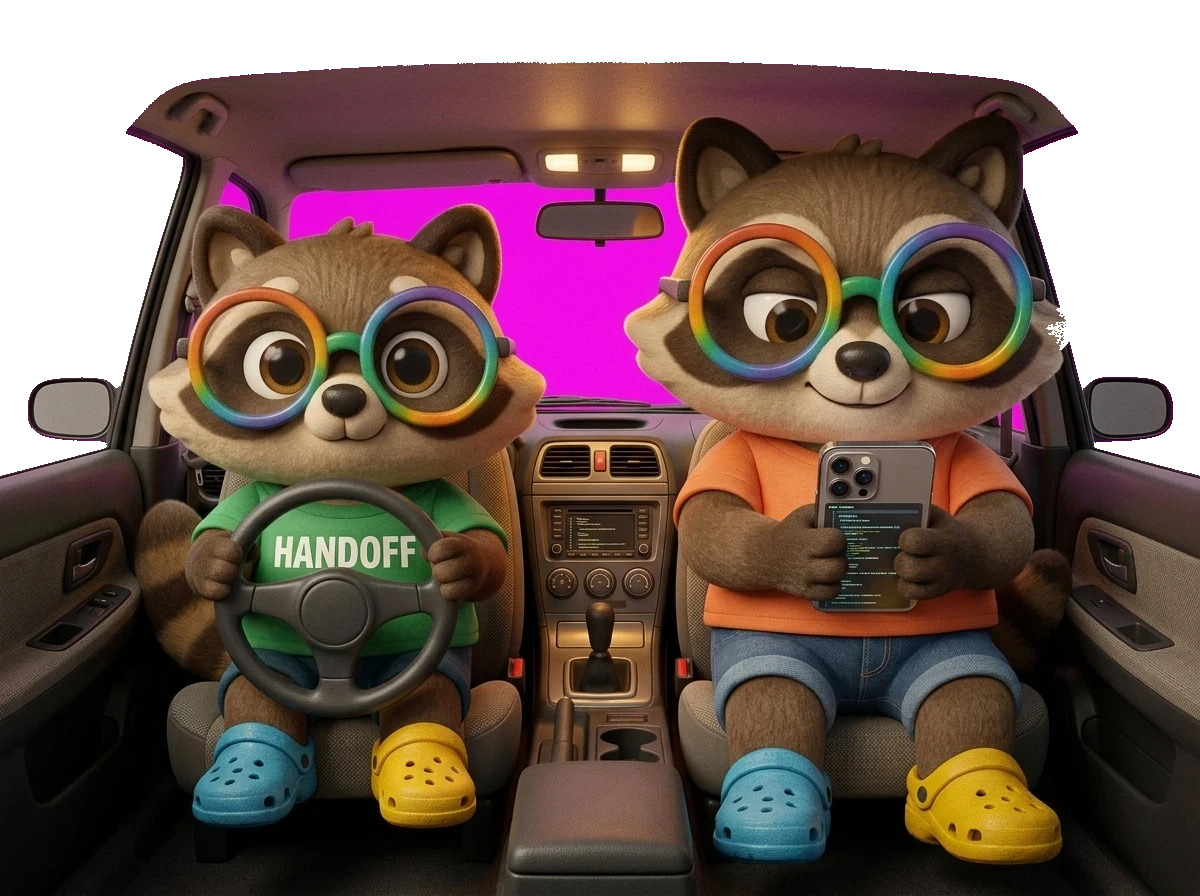
Zach took one look at the illustration and said: “We’re backwards. The picture makes it look like we’re British.” He’s right — the AI put the driver on the right-hand side of the car. The sixteen-year-old who is literally the car-whisperer in this story reviewed the AI’s rendering of himself and caught the bug before his dad did. Correct seat assignments, it turns out, are a feature the passenger-seat vibe-coder is not qualified to QA.
2026-04-15
Balloons on the Hood Canal Trails
Spring break at Hood Canal, hiking with a Qualatrix 160 and a dozen balloons in the cargo pockets. PNW trails are lousy with grumpy kids dragging thirty feet behind their parents, convinced the forest is personally punishing them. Every one of them is a ten-second fix — pull out a balloon, make a dog, hand it over, watch the rest of the hike rewire itself.
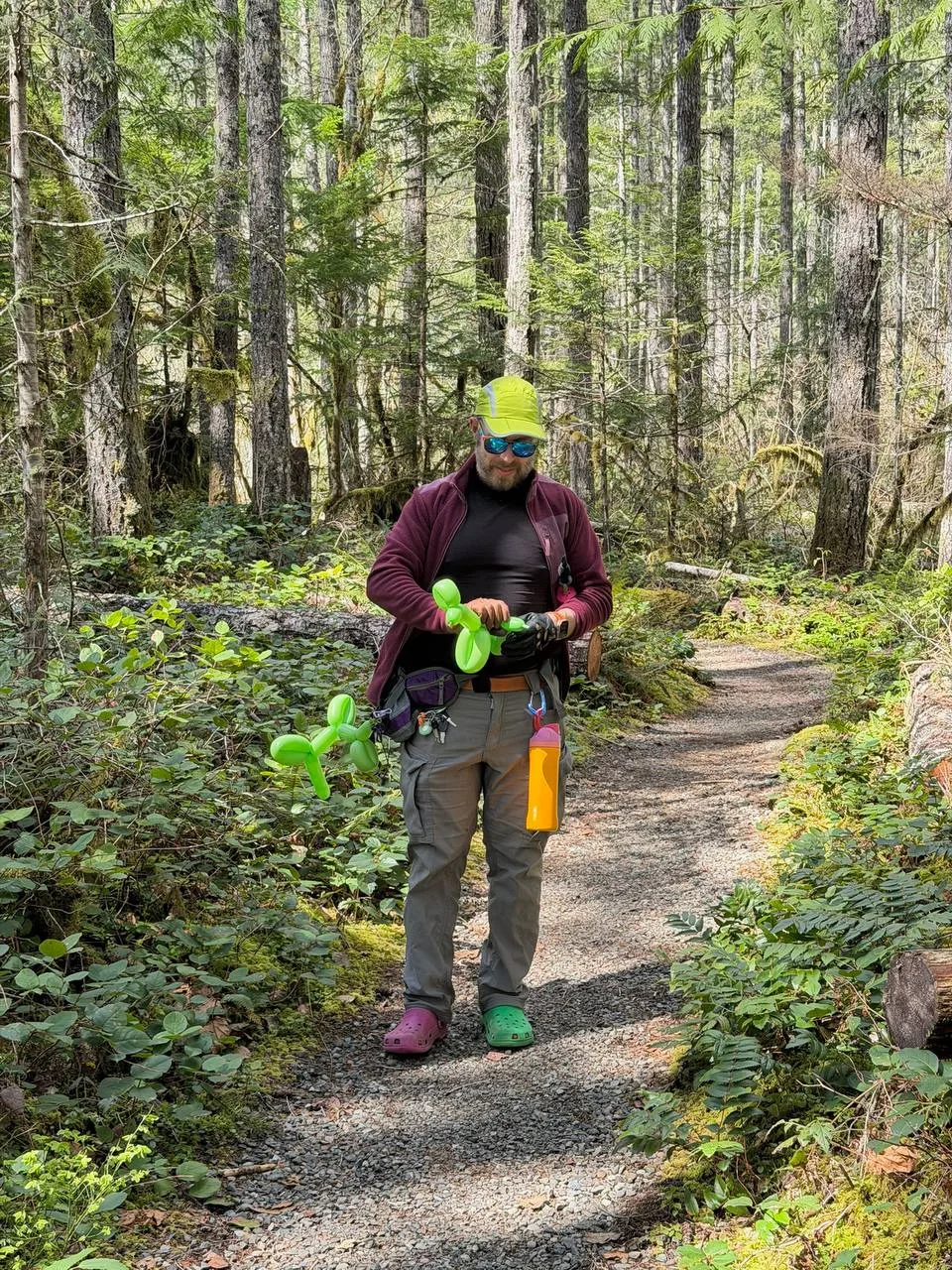
The balloon isn’t really for the kid. It’s for the parents, who get the real gift: the kid walking on their own power again, the grumbling stopped, the memory of the hike becoming “that was fun” instead of “that was awful.” Low cost of materials, lower cost of time, absurd leverage on the emotional arc of somebody else’s afternoon.
See the main ballooning post for the pump recommendation and why this is a universally-stocked day-hike upgrade.