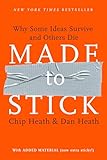
Why does a made-up story about a man waking in an ice-filled bathtub with one kidney stolen travel the globe for fifteen years, while the strategy memo you sweated over dies the moment it leaves the room? Chip and Dan Heath spent a decade on that question and found six traits shared by ideas that stick: Simple, Unexpected, Concrete, Credible, Emotional, Stories — which spell SUCCESs. The villain fighting you the whole way is the Curse of Knowledge: once you know something, you can’t remember what it was like not to know it, so you bury the lead, talk in abstractions, and quote numbers nobody feels. This is a nurture book. Sticky ideas are made, not born, and the six traits are a checklist anyone can run.
AI-augmented, roughly 70% AI (what this means)
I love AI, and I use it on posts like this one partly to get better at using it. The percent is a rough guess: after rounds of prompting, rewriting and editing, it's very hard to say which words came from whom.
- The Curse of Knowledge
- 1. Simple — find the core, then say it compactly
- 2. Unexpected — break the guessing machine, then fix it
- 3. Concrete — paint with sensory detail
- 4. Credible — let ideas carry their own credentials
- 5. Emotional — make people care
- 6. Stories — get people to act
- The big takeaway
- Resources
The Curse of Knowledge
Start with the villain, because every chapter is really a strategy for beating it. In 1990 a Stanford grad student named Elizabeth Newton ran a game with two roles, tappers and listeners. Tappers picked a famous song — “Happy Birthday,” “The Star-Spangled Banner” — and tapped the rhythm on a table. Listeners guessed. Before each round, tappers predicted that listeners would get it about half the time. The actual hit rate was 2.5% — three songs out of 120.
The gap is the whole book. When you tap, you hear the full orchestra in your head. The listener hears disconnected knocks, like bizarre Morse code. You can’t un-hear the tune, and that’s the curse: your own knowledge makes it physically hard to imagine not having it. Reversing it is “as impossible as un-ringing a bell.” There are only two reliable ways to beat the Curse of Knowledge — don’t learn anything, or transform your idea so it survives the trip to someone who doesn’t share your head. SUCCESs is how you transform it.
A quick gut check the Heaths run early: “maximize shareholder value.” Simple? Short, but not useful. Unexpected? No. Concrete? Not at all. Emotional? No. A story? No. Now run JFK’s “put a man on the moon and return him safely by the end of the decade” through the same filter — it passes on every count. Same goal, opposite stickiness. Most of what we say at work sounds like the first one.
The Heaths call this a nurture book. Stickiness looks like a gift — some people just have it — but it’s closer to a craft. An Israeli team collected 200 award-winning ads and found 89% fit just six templates; when they spent two hours teaching novices those templates, outside judges rated the novices’ ads 50% more creative than untrained peers’. Whatever can be taught in an afternoon isn’t magic.
1. Simple — find the core, then say it compactly
The Army builds staggeringly detailed plans and then tells its officers the plans are mostly useless, because “no plan survives contact with the enemy.” So in the 1980s it added Commander’s Intent — a plain-language statement at the top of every order naming the single desired end-state. Not the steps, the destination. If everyone knows the destination, they can improvise their way there when the plan falls apart, which it will. Officers find their intent by finishing two sentences: if we do nothing else tomorrow, we must do what? And the single most important thing tomorrow is what?
Find the core
Simple does not mean dumbed-down. It means finding the core and being ruthless about everything else. Herb Kelleher ran Southwest for decades on one line: “We are THE low-fare airline.” His parable — when marketing wants to add a chicken Caesar salad on the Houston–Vegas route, you ask whether a salad makes you THE unchallenged low-fare airline, and if not, “we’re not serving any damn chicken salad.” That one idea let thousands of employees make decisions Kelleher would never see. Saint-Exupéry’s definition of elegance fits: perfection is reached “not when there is nothing left to add, but when there is nothing left to take away.” Finding the core is the same muscle as writing a good lead — forced prioritization down to the one thing.
Don’t bury the lead
Journalists put the most important fact first — the inverted pyramid — so a reader who quits after one sentence still gets the point. “Burying the lead” is starting with something interesting but secondary and never getting to what matters. Nora Ephron remembers the day her journalism teacher handed the class a pile of facts about a faculty trip to Sacramento with famous speakers, and every student dutifully wrote a lead cramming the names together. The teacher’s lead: “There will be no school next Thursday.” The point wasn’t the facts. It was what they meant. James Carville did the same triage in 1992 — three phrases on a whiteboard, one of them “It’s the economy, stupid” — and stopped Bill Clinton, a man who wanted to talk about everything, from burying his own lead. If you say three things, you don’t say anything.
Names, names, and names
Hoover Adams ran the Dunn, North Carolina paper to a readership penetration of 112% — more than one copy per household — on a single proverb. Asked his secret, he said, “It’s because of three things: names, names, and names.” He’d happily hire more typesetters and run more pages if reporters could fill them with local names. He drove it home with deliberate exaggeration: “If an atomic bomb fell on Raleigh, it wouldn’t be news in Benson unless some of the debris and ashes fell on Benson.” Names trump costs. Names trump good prose. Names trump nuclear explosions in the next county. That’s a core, communicated so hard that nobody on staff can misread it.
Why the core rescues people
A clear core does more than aid memory — it rescues people stranded between good options. Offered a cheap Hawaii vacation right after an exam, students bought it 57% of the time if they’d passed and 54% if they’d failed; but when they didn’t yet know the result, the majority paid five dollars to wait two days, even though they’d go either way. Uncertainty by itself freezes us. So does abundance: students choosing between a lecture and studying chose to study 21% of the time, but add a third option — a foreign film — and 40% studied, because two tempting alternatives were harder to choose between than one, so more people fell back to the books. The people you’re talking to make decisions in that fog all day. A sharp core is what lets them move — “THE low-fare airline” ends the chicken-salad debate before it starts.
Pack meaning with what’s already there
A core has to be compact — there’s a hard limit on what people can hold at once. Try it: stare at “J FKFB INAT OUP SNA SAI RS” for a few seconds and you’ll recall maybe seven letters, but regroup the very same letters as “JFK FBI NATO UPS NASA IRS” and it’s effortless — each chunk is one flag planted on something already in your memory. The trick to packing a profound idea into a few words is to plant those flags. Tell someone a pomelo is “the largest citrus fruit, rind very thick but soft” and they’ll forget it; tell them it’s “basically a supersized grapefruit” and it sticks, because it borrows the whole grapefruit schema, including how it’d taste in orange juice. Hollywood lives on this: “Die Hard on a bus” (Speed), “Jaws on a spaceship” (Alien). Five words green-light a hundred-million-dollar film and tell the set designer the ship should be rickety and sweaty, not the gleaming Enterprise. The best of these are generative — Disney’s employees aren’t staff, they’re “cast members” who audition for roles, wear costumes, and go “onstage” in the park. From four words an employee can predict how to behave in situations nobody scripted. Contrast Subway’s “sandwich artists,” the evil twin of the cast member: it guides nobody, because no one actually wants freeform artistic expression on their sub.
2. Unexpected — break the guessing machine, then fix it
A flight attendant named Karen Wood opened her safety announcement with, “If you haven’t been in an automobile since 1965, the proper way to fasten your seat belt…” and “there might be fifty ways to leave your lover, but there are only six ways to leave this aircraft.” Passengers applauded a safety briefing. She broke the pattern. Our brains tune out the constant — the AC hum, the standard spiel — and snap awake at change.
Surprise is the tool. The Ad Council ran a spot for the “Enclave” minivan, full of cup holders and cable channels and wholesome kids, until a speeding car broadsides it at an intersection. “Didn’t see that coming? No one ever does. Buckle up.” There is no Enclave. The ad works because it breaks two schemas at once — minivans in commercials don’t crash, and neighborhood drives don’t end in disaster — and aims the surprise straight at its core message. Surprise comes from your “guessing machine” failing; the surprise brow, that cross-cultural raised-eyebrow look, is your body forcing your eyes open to take in what you missed.
Surprise needs insight, not gimmickry
A Super Bowl ad once showed wolves attacking a marching band. Memorable, useless — nobody can name the product, because the surprise had nothing to do with the message. To be satisfying, a twist has to be “post-dictable”: unforeseeable beforehand, obvious in hindsight, like the ending of The Sixth Sense and not “it was all a dream.” The fix is to target the surprise at the counterintuitive core of your idea.
Push common sense to uncommon sense
“Great customer service” is common sense and slides right past people. Nordstrom instead tells new hires about the “Nordies” — the one who ironed a customer’s shirt for an afternoon meeting, the one who gift-wrapped a present the customer bought at Macy’s, the one who refunded a set of tire chains even though Nordstrom doesn’t sell tire chains. Those stories detonate the recruit’s old definition of service and rebuild it. Warming a customer’s car in winter is uncommon sense, and uncommon sense is what sticks.
Curiosity is a gap you have to open
Robert Cialdini noticed the best science writing opens with a mystery. An astronomer asked what the rings of Saturn are made of, and why three famous teams reached three different answers — and held readers through twenty dense pages to learn the answer was dust. George Loewenstein’s gap theory explains it: curiosity is the pain of a hole in your knowledge, an itch you have to scratch. So you have to open gaps before you fill them. Stop asking “what information do I need to convey?” and start asking “what questions do I want my audience to ask?” Roone Arledge made strangers care about a college football game in a town they’d never visit by feeding them enough context — the rivalry, the campus, the crowd — to turn an abyss of indifference into a gap worth closing. And a gap doesn’t have to be small to grab people: Sony’s “pocketable radio” and Kennedy’s man on the moon were audacious enough to be provocative, concrete enough to start engineers brainstorming the first step.
Make people feel the gap
The gap theory has a catch: people think they already know what they don’t. Asked to brainstorm fixes for their own campus parking mess, people generated barely 30% of what an expert panel found — while estimating they’d gotten 75%. The cure is to make them commit before you reveal. Eric Mazur, a Harvard physicist, stops mid-lecture and makes students vote out loud on a concept; staking a public answer makes them care whether they were right. Nora Ephron’s teacher did the same by having the class write the wrong lead first. A prediction you’ve put your ego behind opens a gap that no lecture can.
3. Concrete — paint with sensory detail
Aesop’s fox can’t reach the grapes and decides they’re sour, and 2,500 years later “sour grapes” lives in dozens of languages. The truth survived because of how it was encoded — a fox, grapes, a dismissive line — not because it was true. Plenty of true things never stick. “Aesop’s Helpful Suggestions: don’t be a bitter jerk when you fail” would have died in a generation.
Concrete means something you can examine with your senses. A V8 engine is concrete; “high-performance” is abstract. Abstraction is the luxury of the expert — the judge thinks in precedent while the juror remembers the Darth Vader toothbrush — and the expert’s drift into abstraction is the Curse of Knowledge in action. When Beth Bechky studied a chip-machine maker, the engineers answered factory-floor problems by making their blueprints more elaborate and more abstract, “like American tourists who try to make themselves understood by speaking English more slowly and loudly.” The fix wasn’t meeting in the middle. It was solving problems on the machine itself — the one language everyone spoke fluently.
Concrete builds understanding
Concreteness isn’t only memorable, it’s how novices learn anything at all. Comparing math classrooms, researchers found Japanese and Taiwanese teachers taught in context — “You had 100 yen and bought a notebook for 70, how much is left?”, tiles slid off a desk to show subtraction — about twice as often as American teachers (61% of lessons versus 31%). Two accounting professors ran an entire semester as a single story: Kris and Sandy, two sophomores launching a gadget, with you as their accountant. The difference between fixed and variable cost wasn’t defined, it was discovered the day they bounced a check despite record sales. Two years later, in the next course, the students who’d lived that soap opera scored higher — the C-students by a full twelve points. You can’t start a house by building the roof in midair; abstraction needs a concrete foundation under it.
The Velcro theory of memory
Memory is less a filing cabinet than Velcro: thousands of hooks meeting thousands of loops. The more hooks an idea has, the better it sticks. “Your childhood home has a gazillion hooks in your brain. A new credit card number has one, if it’s lucky.” Jane Elliott didn’t teach prejudice as a fact in 1968 — she split her third-graders by eye color, made the blue-eyed kids wear collars and sit in back, and watched friendships curdle within an hour. Twenty years later her students were measurably less prejudiced. She turned an abstraction into an experience with hooks they couldn’t shake.
Concrete coordinates people
A deliberately concrete target aligns experts who’d otherwise pull in different directions. Boeing didn’t tell its teams to build “the best passenger plane in the world.” The 727 had to seat 131 passengers, fly nonstop Miami to New York, and land on La Guardia’s Runway 4-22 — short enough that no existing jet could use it. Thousands of engineers coordinated against that one picture. When the Nature Conservancy faced too much California land to ever buy, it stopped talking in millions of unpicturable acres and started naming “landscapes” — christening a stretch of brown hills the “Mount Hamilton Wilderness.” The Packard Foundation funded it; other groups started using the name. As they laughed, “you know we made that up.” It’s not a set of acres anymore. It’s an eco-celebrity.
4. Credible — let ideas carry their own credentials
People constantly ask, “who’s behind this, and what do they get if I believe it?” Sometimes you borrow credibility from an authority — a surgeon general, a celebrity. Most of us can’t. The surprise of this chapter is that the obvious sources, expert endorsement and hard statistics, are often the weakest, and that an anti-authority, a vivid detail, or a test the audience runs themselves beats a wall of credentials.
The ulcer story is the parable. In the early 1980s Barry Marshall and Robin Warren found that bacteria, not stress and acid, cause most ulcers — curable with antibiotics in days. Nobody believed them: stomach acid dissolves a nail, so bacteria surviving there “would be like stumbling across an igloo in the Sahara,” and “a medical researcher in Perth is like a physicist from Mississippi.” So in 1984 Marshall drank a glass of roughly a billion of the bacteria. “It tasted like swamp water.” Days later he was sick, his stomach lining inflamed; he cured himself. They won the Nobel Prize in 2005.
Anti-authorities and vivid details
When you lack a famous name, recruit an honest one. The anti-smoking campaign used Pam Laffin — not a doctor or a star, a smoker who started at 10, had emphysema by 24, and died at 31. Her credibility came from firsthand truth, not status. Inside an idea, concrete details do the same work. In a mock custody trial, jurors heard balanced arguments, but one side got the irrelevant detail that the boy brushed his teeth with a Star Wars toothbrush shaped like Darth Vader. The toothbrush — useless to the case — made the diligent-mother claim believable and swung the verdict.
Statistics show a relationship, not a number
Use statistics to illustrate a relationship people will remember, not digits they’ll forget. To convey the nuclear arsenal, Beyond War didn’t cite warhead counts; they dropped one BB in a metal bucket (“the Hiroshima bomb”), then ten, then poured in 5,000. “The roar went on and on. Afterward there was always dead silence.” Whether the count was 4,135 or 9,437 was irrelevant — the scale-up was the point. And put numbers on a human scale: “throwing a rock from the sun to the earth and landing within a third of a mile” impresses fewer people than the identically accurate “from New York to Los Angeles within two-thirds of an inch.” Stephen Covey pulled the same trick on a dreary statistic — a survey where only 37% of 23,000 employees understood what their organization was trying to achieve — by recasting it as a soccer team where only 4 of the 11 players know which goal is theirs, only 2 care, and most are somehow competing against their own teammates.
The Sinatra Test and testable credentials
One example can certify a whole domain — the Sinatra Test, from “if I can make it there, I’ll make it anywhere.” An Indian shipper won a paranoid Bollywood studio by noting it had delivered the new Harry Potter to every bookstore in India, all on shelves by 8 a.m. on release day, with no leaks. If you can do that, you can protect anything. Best of all, hand the test to the audience. Wendy’s didn’t claim “11% more beef”; Clara Peller lifted the bun and demanded “Where’s the beef?” — a claim anyone could check with a ruler. Reagan didn’t recite inflation figures; he asked, “Are you better off than you were four years ago?” and let each voter run the test. (Selling leans on this same move — let people convince themselves.) It can backfire when the test is real but the conclusion isn’t: a 1990s rumor urged people to “see for yourself” that Snapple backed the Klan, pointing to a slave ship on the label (actually an engraving of the Boston Tea Party) and a circled K (it means kosher). A verifiable detail walked people straight into a lie.
5. Emotional — make people care
Belief isn’t enough; people act on feeling. The engine is the power of one. Mother Teresa: “If I look at the mass, I will never act. If I look at the one, I will.” In a Carnegie Mellon study, a letter full of statistics about millions of starving Africans drew $1.14 in donations; a letter about one seven-year-old girl named Rokia drew $2.38. Combine the statistics with Rokia and giving dropped back to $1.43 — the numbers actually suppressed the feeling. A follow-up proved why: prime people to do arithmetic first and their giving falls, because “the mere act of calculation reduces charity.” Once the analytical hat is on, the heart goes quiet.
Appeal to self-interest — and not just the basement
The most reliable lever is what’s in it for them. John Caples wrote the most famous headline in advertising history in 1925 — “They laughed when I sat down at the piano, but when I started to play!” — and built mail-order advertising on one rule: sell the benefit of the benefit. “People don’t buy quarter-inch drill bits. They buy quarter-inch holes so they can hang their children’s pictures.” In a 1982 cable-TV study, the pitch that made homeowners imagine themselves subscribing more than doubled sign-ups — 47% versus 20% — over the one that just listed the benefits. But don’t camp in Maslow’s basement of money and security. Asked which pitch for a $1,000 bonus would move them most — paying down a car, padding a rainy-day fund, or “the company recognizes how important you are” — most people choose recognition for themselves while assuming everyone else just wants the cash. We each think we live a floor above the crowd, so aim higher than you’d guess. Floyd Lee came out of retirement to run a chow hall near the Baghdad airport with the same Army menu as everyone else, yet soldiers braved a deadly road to eat there. His line: “I am not just in charge of food service; I am in charge of morale.” His staff made decisions by asking, “what should a Pegasus person do?”
Appeal to identity
People also decide by asking “what does a person like me do here?” That’s why a fire department refused to review a safety film for a free popcorn popper — “do you think we’d use a fire safety program because of some popcorn popper?” Firefighters aren’t people who need little gifts. Texas couldn’t fund or shame its way out of a $25-million litter problem until it profiled the typical litterer — a young, pickup-driving, sports-and-country-music man who hated being told what to do, nicknamed “Bubba” — and convinced him that people like him don’t litter. Dallas Cowboys crushing beer cans, Willie Nelson, “Don’t Mess with Texas.” Litter fell 72% over five years. Not fear, not self-interest. Identity.
The Truth anti-smoking campaign ran the same play. Rather than warn teenagers about lung disease — a bet that never pays with teenagers — it aimed at their hatred of being manipulated: kids stacking 1,800 body bags outside a tobacco company, one for each American killed that day. Teens who saw Truth were 66% less likely to smoke; teens who saw Philip Morris’s earnest “Think. Don’t Smoke.” were 36% more likely. Rebellion is an identity too, and identity beats fear.
Worn-out words stop working
Emotional words wear out through “semantic stretch.” When everyone calls everything “unique,” unique stops meaning rare — newspaper use of the word climbed 73% over twenty years as it bled its meaning. “When everyone paints with lime green, lime green no longer stands out.” When your finance professor starts saying “dude,” retire the word.
6. Stories — get people to act
A credible idea makes people believe and an emotional idea makes them care, but the right story makes them act, because a story does two things at once: it simulates and it inspires. Hearing a story isn’t passive — your brain runs it like a flight simulator, firing many of the same regions as the real thing. A nurse in a neonatal ICU watched a baby turn blue-black and overrode the whole team, who read the steady monitor and assumed a collapsed lung; she knew the heart’s sac was filling with air, pushed their hands away, and saved the baby. The monitor measured electrical activity, not actual beats. The story teaches the specific lesson and a deeper one — don’t blindly trust the machine — far better than a bullet point ever could.
Why simulation works
The flight-simulator line isn’t a metaphor. Imagine a flashing light and your visual cortex activates; imagine words that start with “b” and your lips move a little. So a story is rehearsal. UCLA researchers gave students a problem and had one group picture a happy ending and another mentally replay, step by step, how the mess arose — five minutes a day for a week. The ones who replayed the messy process, not the rosy outcome, came out in better moods and far likelier to have actually done something about it. A review of 35 studies found that mental practice alone delivers roughly two-thirds the gain of physical practice. A good story is reps in the simulator before the real thing.
Spot, don’t invent
You don’t have to write great stories. You have to recognize them when life hands them over, then resist the urge to abstract them into a slogan. “You can extract a moral from a story, but you can’t extract a story from a moral.” Learn the three plots so you can spot the gift:
- Challenge — the underdog against a daunting obstacle (David and Goliath, or Rose Blumkin, who slipped out of Russia at 23 with no English and built a $100-million furniture business, still working the floor at 100). It makes people want to work harder and persevere. Use it to kick off a hard project.
- Connection — a bond across a gap of race, class, or rank (the Good Samaritan). It makes people more tolerant and generous. Use it at the holiday party.
- Creativity — the mental breakthrough (Newton’s apple). It makes people experiment. Use it when you want a team to try something new.
Springboard stories
Hit people with a bald argument and they argue back; tell a story and the skeptical little voice in their head goes quiet and starts working for you. At the World Bank in 1996, Stephen Denning couldn’t sell “knowledge management” until he told one story: a health worker in a small Zambian town 360 miles from the capital found malaria answers on the CDC’s website in Atlanta. Executives rushed up afterward — “they’ve stolen my idea, it’s become their idea.” A springboard story lets each listener spring to their own version of the future, which is exactly why it creates buy-in.
Jared
The book’s recurring case ties it all together. Jared Fogle hit 425 pounds and 60-inch-waist pants in college, then lost about 245 pounds eating Subway. A franchise owner spotted a student-paper article, an ad agency chased it down, and the spots aired on January 1, 2000. Subway’s national marketing had rejected it — “fast food can’t do healthy.” Sales were flat in 1999, then jumped 18% in 2000 and another 16% in 2001. Run Jared through the checklist: Simple, Unexpected, Concrete, Credible — the anti-authority who wore 60-inch pants is giving you diet advice — Emotional, and a Story. A guy and his old pants beat a national marketing budget.
The big takeaway
The book practices what it preaches, so the summary is itself a checklist. Each principle answers one question and is anchored by one example you won’t forget.
| Principle | The question it forces you to answer | The example that proves it |
|---|---|---|
| Simple | What’s the one core? | Southwest: “We are THE low-fare airline” |
| Unexpected | How do I win attention and keep it? | The minivan ad that ends in a crash |
| Concrete | Will this mean the same to everyone? | Boeing: “131 passengers, Miami to New York, Runway 4-22” |
| Credible | Why should they believe me? | Wendy’s: “Where’s the beef?” |
| Emotional | Why should they care? | One girl named Rokia, not three million statistics |
| Stories | Will they actually act? | Jared and his 60-inch pants |
Behind all six stands the Curse of Knowledge. The reason your idea isn’t sticking usually isn’t that it’s wrong — it’s that you can hear the tune in your head and your audience can’t. The fix isn’t to tap louder. It’s to transform the idea until the song comes through.
One more freeing point: it’s easier to spot a great idea than to generate one, because the world produces more good ideas than any single person can. A great spotter beats a great creator. Most of the heroes here weren’t geniuses — a flight attendant, a small-town editor, a journalism teacher, a mess-hall cook, a Subway franchisee. They just kept their core in focus and recognized a sticky idea when it walked past.
Resources
- Switch — the Heath brothers on changing behavior when change is hard
- Engineering Moments — the Heath brothers on designing peak experiences (The Power of Moments)
- Decision making 201 — my notes on the Heaths’ Decisive
- To Sell Is Human — Dan Pink on moving people, the same persuasion turf
- Writing is Thinking — finding the core is the same muscle as writing a good lead
- Heath Brothers — the authors’ site, with more sticky-idea worksheets