What does it mean to be an engineering manager when AI is rewriting every assumption you have about software, teams, and your own role? I don’t know yet. Nobody does. But I’m figuring it out in real time, and these are my notes from the chaos.
AI-augmented, roughly 50% AI (what this means)
I love AI, and I use it on posts like this one partly to get better at using it. The percent is a rough guess: after rounds of prompting, rewriting and editing, it's very hard to say which words came from whom.
- What is AI Native?
- The Year of Chaos, The Year of Wonder
- The AI Native EM Job
- What Translates from the Old World
- Making AI a Team Sport
- Open Questions
- User Requested Questions
- Appendix: New Words for a New World
- Appendix: Hot Takes
- Appendix: Old Questions, New Answers
What is AI Native?
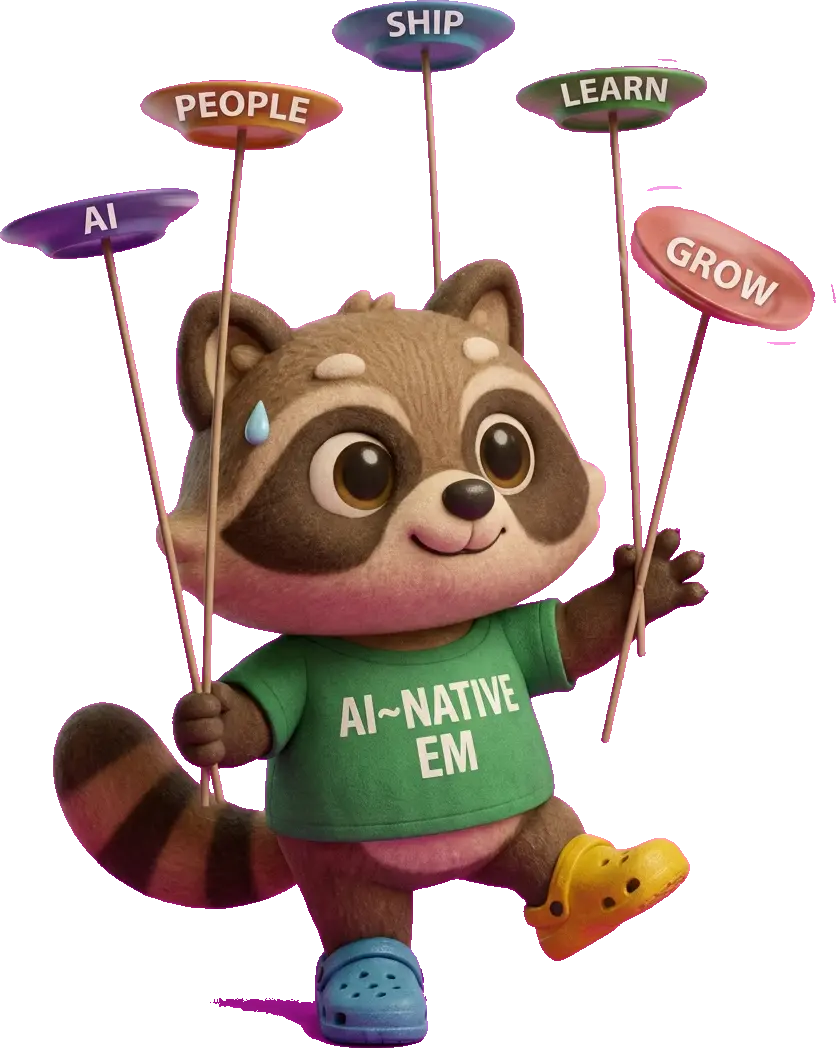
AI native doesn’t mean “we use AI.” Everyone uses AI. AI native means you reimagine the world assuming AI exists from the ground up. You don’t bolt AI onto your existing processes — you ask what processes would look like if you designed them today, knowing what AI can do.
The Year of Chaos, The Year of Wonder
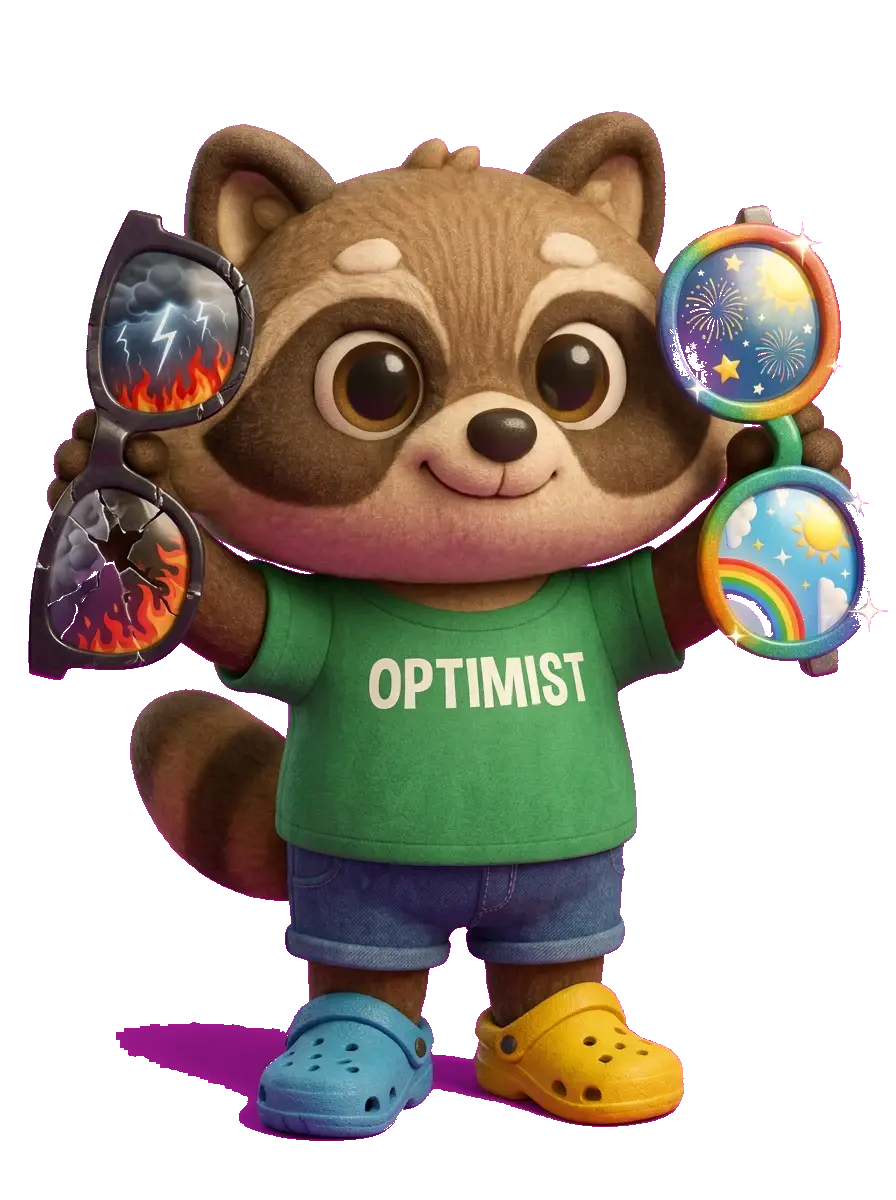
Pessimists are right, but optimists are successful.
Same facts. Same chaos. What separates the managers who thrive from the ones who drown is the mental frame they bring to it. You can look at AI and see a threat to everything you’ve built — or you can see the biggest expansion of what’s possible in your entire career. Both readings are defensible. Only one of them leads somewhere good.
The Year of Chaos
The definition of roles is completely changing, and we don’t know to what. And we have to switch to the new roles while we keep doing our day job. It’s like rebuilding the airplane while flying it, except someone also keeps changing what an airplane is.
Every few days we find out something that shatters our world views and assumptions.
Every week there are 30 new things to look at. 29 of them are probably trash. But you don’t know which one isn’t, and you can’t afford to miss it.
The Year of Wonder
The same chaos that exhausts you is also the most creative period in the history of software. Your team can build in a week what used to take a quarter. Junior engineers are punching above their weight class. Problems you shelved years ago because “we’ll never have the bandwidth” are suddenly tractable.
If you only see the chaos, you’ll manage defensively — tightening processes, slowing down, protecting what exists. If you also see the wonder, you’ll manage expansively — experimenting more, raising ambitions, asking “what could we build now that we couldn’t before?”
Choosing Your Frame
The pessimist’s frame is accurate: jobs are changing, skills are devaluing, nobody knows what’s next, and half the AI hype is garbage. All true.
The optimist’s frame is also accurate: the tools are extraordinary, the ceiling on what small teams can achieve has exploded, and the managers who lean in will define the next era. Also true.
You don’t get to pick the facts. You get to pick which facts you orient around. The managers who orient around wonder — while staying honest about the chaos — are the ones whose teams want to follow them into the unknown.
The AI Native EM Job
First Principles: Help People Build Effectively
Strip away the buzzwords and the EM job hasn’t changed at its core: help people be the most effective at their building job. What’s changed is what “effective” looks like, what “building” means, and how fast both of those keep shifting.
The AI Chasm: Assessment and Adoption Stages
People don’t adopt AI in a straight line. They go through stages, and your job as an EM is to figure out where each person is and help them move forward. Not everyone is in the same place, and that’s fine. What’s not fine is leaving people stuck.
- Denial — “This doesn’t apply to my work.” “It’s just autocomplete.” They haven’t tried it, or tried it once six months ago and dismissed it.
- Skepticism — “I tried it and it’s not that good.” They’ve used it but hit the trough of disillusionment. The output wasn’t magic, so they bounced.
- Fear — “Is this going to replace me?” They see it working for others and feel threatened rather than empowered. This is where people get paralyzed.
- Frenzy — “I’m going to AI everything!” They’ve crossed the chasm and are overcorrecting. Working 12-hour days with Claude Code, trying to 10x everything, setting unsustainable pace.
- Burnout — The crash after the frenzy. Yegge’s AI Vampire. Nap attacks, exhaustion, cynicism about the very tools they were excited about last month.
- Sustainable Execution — The goal. They know when to use AI and when not to. They’ve built it into their workflow without it consuming them. They’re faster and they’re not dying.
Your job is to assess where each person is and meet them there. You can’t drag someone from Denial to Frenzy — they’ll just snap back. And you can’t let someone burn in Frenzy without intervention.
Coaching Through the Chasm
I heard someone say: if the people you support aren’t scared shitless of AI taking their jobs, you need to get them there — and then get them past there. That sounds harsh, but there’s wisdom in it. Fear is a necessary waypoint, not a destination. People who skip Fear and jump straight to Frenzy crash harder. People who never reach Fear stay in Denial or Skepticism and get left behind.
Denial → Skepticism: Don’t argue. Show, don’t tell. Pair with them. Have them watch you use AI on their actual codebase, not a toy demo. The gap between “I tried ChatGPT once” and “I watched someone use Claude Code on my repo” is enormous.
Skepticism → Fear: This is where you need to be honest, not comforting. Show them what’s coming. Share what other teams are shipping, how fast the tools are improving, what the industry looks like in 6 months. The goal isn’t to terrorize them — it’s to create genuine urgency. If they’re not a little scared, they’re not paying attention.
Fear → Frenzy: This is the hardest transition to coach because you’re not pushing — you’re catching. Fear paralyzes. Your job is to make it safe to experiment. Give them low-stakes projects to try AI on. Celebrate ugly first attempts. Pair them with someone in Sustainable Execution, not someone in Frenzy (that’s intimidating, not inspiring). The message: “Your job isn’t going away. Your job is changing. Let’s figure out the new version together.”
Frenzy → Burnout: You mostly can’t prevent this, but you can shorten it. Set boundaries they won’t set for themselves. “You shipped three features this week, that’s enough.” Watch for the signs — sleeping weird, irritable, can’t stop talking about tokens. Name what you see.
Burnout → Sustainable Execution: Give them permission to slow down. Remind them that 3 productive hours of AI-augmented work is still massively more output than a pre-AI full day. Help them find their rhythm — not yours, not Yegge’s, theirs.
What Translates from the Old World
I wrote a whole manager book in the pre-AI world. Some of it carries over directly, some of it is the same principle but amplified, and some of it is completely different.
Same But More So
- “Never have a human do what a computer can do” — I wrote this as a process principle. It’s now 100x more true. The surface area of what a computer can do exploded overnight.
- Coaching and the 7 questions — The coaching questions still work. “What’s on your mind?” is still the best opener for a 1:1. But “what’s the real challenge here for you?” now often has AI-shaped answers that neither of you fully understand yet.
- Situational leadership — The four stages (Foolish Novice → Novice → Journeyman → Expert) map directly onto AI adoption. Someone can be an Expert at their domain and a Foolish Novice at AI-augmented work, simultaneously. That’s disorienting for everyone.
- Culture: sustainable execution — “Ship fast, test often, pay down debt, never get stuck” is more important than ever. The Frenzy stage produces a lot of shipped code that creates a lot of debt. Sustainability is the whole game.
- Career development — Career Growth Plans still matter, but the skills you’re growing are shifting under your feet. You need to update what “senior” means when a junior with Claude Code can out-produce a senior without it.
Completely Different
- The 4 dimensions of success — Business Results, People, Process, Tech Assets. The weights are shifting. Tech Assets matter less when code is cattle not pets. People matter more because AI fluency is the multiplier. Process is up for complete reinvention.
- Hiring — See Old Questions, New Answers below.
- Planning and estimation — The execution order (Why → What → When → Who) still holds, but timelines are compressing in unpredictable ways. A project that would have taken a quarter might take a week. Or it might still take a quarter because the hard part was never the code.
- The schedule — My old 44-hour week breakdown (8hrs 1:1s, 6hrs partner meetings, 6hrs reviews…) assumes a stable world where you can plan your week. In the Year of Chaos, you need more slack for learning, experimenting, and helping people through the AI chasm.
Making AI a Team Sport
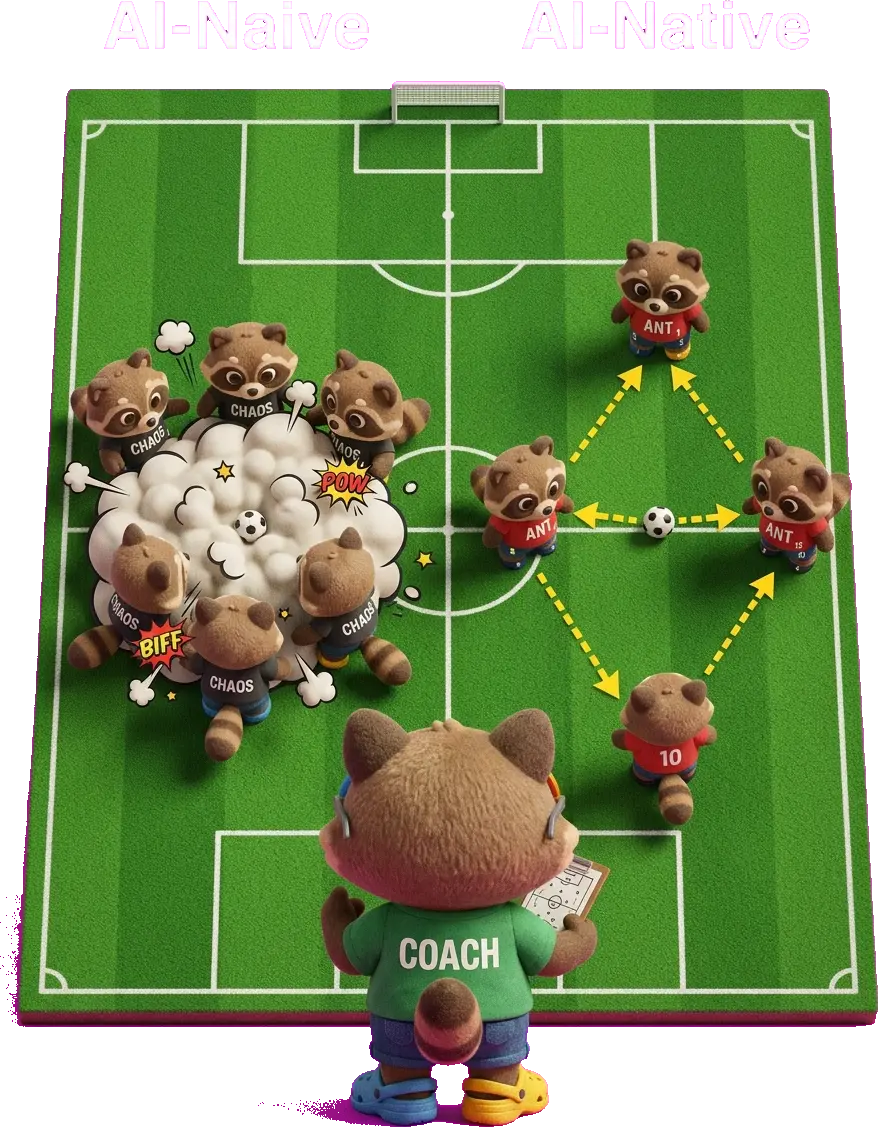
The lone wolf vibe coder gets all the Twitter glory, but that’s not how teams work. Your job as an EM is to make AI a team sport — divide and conquer, match people to their strengths, and make the whole team successful, not just the one person who happens to be in Frenzy.
Divide and Conquer
Ramping up into AI is like ramping up into any new technical space. You don’t have everyone learn everything — you divide the stuff to learn, have folks figure out their piece, and report back to the team. That’s how you turn an overwhelming firehose into manageable streams.
Not everyone needs to be good at the same things. AI opens up new roles within the team that didn’t exist before:
- The Trailblazer — Someone who’s always trying the latest tools, workflows, models. They break things, they find what works, they report back. You need one of these, not five. Let them run ahead and scout.
- The Toolsmith — Someone who takes what the trailblazer finds and turns it into repeatable workflows for the team. CLAUDE.md files, prompt libraries, custom slash commands, shared agent configs. This is infrastructure work and it’s incredibly high-leverage.
- The Skeptic — Someone who pushes back on AI-generated code, catches the hallucinations, insists on tests and reviews. This isn’t Denial — it’s quality. Every team needs someone who says “wait, did we actually verify this works?”
- The Bridge — Someone who translates between AI-fluent and AI-skeptical team members. They can pair with anyone and meet them where they are. Often this is your best coach.
These aren’t formal roles or titles. They’re natural tendencies that people already have. Your job is to notice them and lean in. The trailblazer who’s forced to write docs burns out. The skeptic who’s told to “just trust the AI” checks out. Match people to their strengths.
Share the Learnings
AI fluency compounds faster in teams than in individuals — but only if you create the channels:
- AI show-and-tell — Dedicate time in team meetings for “here’s a cool thing I figured out with AI this week.” Low-stakes, high-signal.
- Shared prompt libraries and configs — One person’s breakthrough becomes everyone’s baseline. This is the integral in action.
- Pair programming with AI — Two people, one AI session. The person driving learns the tools; the person watching catches mistakes and learns the workflow. Rotate.
- Failure sharing — “Here’s where AI completely botched it and what I learned” is more valuable than success stories. Normalize talking about AI failures so people don’t waste time on the same dead ends.
AI Free Zones
While some folks are excited about AI, sometimes we need a break. The AI Vampire is real, and part of making AI a team sport is knowing when to put the ball down.
There are two reasons to create AI-free zones, and both matter:
Don’t stop thinking. If you reach for AI every time something is hard, you stop exercising the muscles that make you good at your job. Deep thinking, system design intuition, debugging by reasoning about code — these skills atrophy when you outsource them. The paradox is that the people who are best with AI are the ones who can think clearly without it. AI-free time is training time for the skills that make your AI-augmented time more effective.
Sometimes you just need a break. Not everything has to be about AI. Social interactions — lunch, coffee, hallway conversations — shouldn’t become another AI discussion forum. People need spaces where they can be humans talking to humans about human things. When every lunch turns into “have you tried this new model?” it gets exhausting, even for the enthusiasts. Consider designating some social time as AI-free: maybe lunch on certain days, maybe Friday afternoon hangouts, maybe the first 10 minutes of every meeting. The right cadence depends on your team, but the principle is: protect some space where people can just be people.
The broader point: a team that only knows how to work with AI is fragile. They need the underlying skills to stay sharp, and they need the social fabric that comes from connecting as humans, not just as AI practitioners.
Open Questions
Things I’m actively trying to figure out:
- Can managers manage more people now? If AI makes each IC more productive, does the EM span of control increase? Or does the opposite happen — you become more of an M2 (manager of managers) because the complexity per person goes up? My instinct: the bottleneck isn’t number of people, it’s surface area. And surface area is exploding.
- What happens to junior engineers? If AI handles the tasks we used to give juniors to learn on, how do people develop? Do we need to deliberately create learning experiences that AI could do faster? I work through the new-hire side of this in AI Native Onboarding.
- What’s the new career ladder? If code is cattle and anyone can produce it, what differentiates a senior engineer from a junior one? Judgment? Taste? System design? The ability to prompt well?
- How do you evaluate performance? Output per person is going up but is wildly uneven depending on AI adoption stage. How do you calibrate fairly across a team where some people are in Frenzy and others are in Denial?
User Requested Questions
These are questions people have asked me that I don’t have good answers for yet. If you’re an EM in the AI age, you’re probably asking these too.
- How did trailblazing actually work? How do you have a single team look at the entire breadth of AI improvement every week and decide what to assess, how to assess it, and what to keep? Does every team have to do it all?
- What do you actually do with the old world dev who isn’t adopting? The coaching model is nice in theory. But when someone stays in Denial after months of investment, then what?
- How do you manage the dev who is producing massive amounts of code? How do you know if it’s good? Does someone have to read every line? Do 2 people have to?
- How do you deal with work products that 0 people have read? Specs produced by AI, and no one has carefully looked at the testing or release section. Giant PRs with files or long sections written entirely by AI.
- Are those of us who aren’t going to get fired in the next 6 months on a path to extreme burnout?
- Why don’t you fire half your devs? Fire 90% of your devs? If AI makes everyone 2-10x more productive, why not just cut?
- Why not flatten the org? Instead of EMs there are just cattle ranchers.
- What does an M2 do these days? An M3? Are their jobs changing?
Appendix: New Words for a New World
AI is spawning a bunch of new terms — some useful, some hype. I keep the running glossary in its own post, AI Native Vocabulary: Functional Collapse, Cognitive Debt, Heresies, Deep Blue, Infinite Loop, In Distribution, and more.
Appendix: Hot Takes
Should XFN Code?
Depends on why.
If the goal is to speed up the engineering team by having PMs and designers submit PRs — probably not. There’s a reason many mature teams stopped accepting outside PRs: the review cost, the context-switching, the “helpful” code that doesn’t fit the architecture. A PM writing code to ship a feature faster often creates more work for engineers, not less.
But if the goal is something else, then yes:
- To explore and explain — A PM who can vibe-code a prototype to show what they mean? Incredibly valuable. That’s not a PR, it’s a communication tool. Worth more than any spec doc.
- To build bespoke tooling — A designer who builds their own Figma-to-component pipeline, a PM who automates their own metrics dashboards, a TPM who scripts their own status tracking. These are productivity tools for themselves, not contributions to the engineering codebase.
- To build agentic workflows — XFN building agents that automate their own domain tasks (data analysis, user research synthesis, A/B test configuration). This is the real unlock — not coding for engineers, but coding for themselves.
The line: are you producing code that engineers need to own and maintain? Then you’re adding to their burden. Are you producing tools that make your own work better? Then go for it.
Appendix: Old Questions, New Answers
Should EMs Code?
In the old world, my answer was: read code occasionally for spot-checking and context, but don’t be on the critical path. AI changes this question completely.
With AI, an EM can vibe-code a prototype in an afternoon that would have taken a week to spec and assign. You can build team tools, automate toil, and stay closer to the technical reality. The cost of coding dropped so much that the old “you can’t afford to code, you have people to manage” calculus is different now.
But the trap is real: if you’re vibe-coding all day, you’re not managing. The AI Vampire doesn’t care about your title. You can burn out just as fast as your ICs, and then who’s looking out for them?
Should I Become an EM?
In the old world, the answer was nuanced — it depends on what you want, what you’re good at, the usual trade-offs. AI changes the calculus significantly.
The financial case is gone. Staff engineers now earn 20-30% more than EMs. The career ladder is shorter — flattened orgs mean fewer senior management positions. And the technical relevance half-life is brutal: the further you drift from the code, the faster the AI landscape leaves you behind.
So why do it? One reason: because you genuinely want to help people build effectively. That’s it. Not for the title, not for the comp, not because it’s the “next step.” If you’re becoming an EM because you think it’s a promotion, don’t. The IC track is objectively better for most people right now.
But if you’re the person who lights up when someone on your team has a breakthrough? If you can’t stop thinking about how to make the team better as a system? Then the role is still there, and it still matters — maybe more than ever, because helping humans navigate the AI chasm is genuinely hard, important work.
How Should Hiring Change?
In the old world, the hiring formula was: Smart, Gets Shit Done, Not an Asshole. Guess what? That hasn’t changed. The fundamentals are the fundamentals.
What changed is “Gets Shit Done” got a fancy new word — Agency. But it’s the same thing it always was: seeing what needs to happen and making it happen, without someone holding your hand. AI didn’t invent agency, it just made it more visible. When AI handles the boilerplate, the people who drive outcomes stand out even more from the people who were hiding behind busy work.
The real question isn’t what to hire for — it’s how to assess it when AI changes what the work looks like. That’s a whole separate rabbit hole.
Field note from the founder side. Shivani Poddar (ex-Google / Deepmind / Meta, now Founder Stealth) recently shared what she looks for in her founding team:
- Excellence in something — “could be athletics, competitive programming, anything. This shows me you have it in you to learn and be the bestest and greatest at something.”
- Founder energy — “that fire in the belly and never-say-never attitude.”
- AI-pilled — “you know how to exponentiate yourself, your stack, your product, and people around you with AI.”
She noted her former colleagues from Google, Meta, and Deepmind resonate with these as much as the new crop of graduates and founding engineers do. That tracks with the argument above: AI didn’t invent agency, it just made the signal louder. The founder-stage variant of “Smart, GSD, Not an Asshole” looks a lot like its big-tech cousin — the bar didn’t move, the noise floor dropped.